




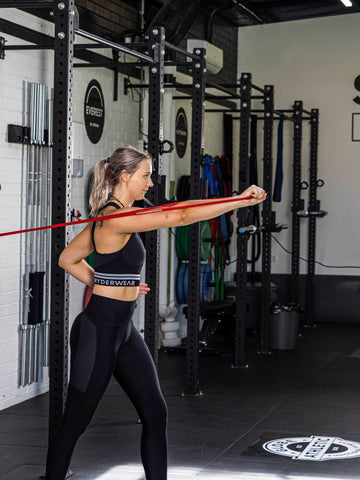
Toned, strong arms don't need a rack of dumbbells — they need tension, and a resistance band delivers plenty of it. Looped, anchored or stood on, one band trains your biceps, triceps and shoulders through their full range, at home, for the price of a coffee or two. This guide gives you twelve exercises with proper form cues, a routine to follow, and the science behind why it works as well as it does.
Quick answer: yes, you can tone and build your arms with resistance bands. Research comparing single-joint upper-body exercises found elastic bands produce muscle activation comparable to free weights1 — and because a band keeps tension on the muscle through the whole movement, your biceps and triceps work hard from start to finish of every rep.
Trusted by 10,000+ Australians — including coaches and physiotherapists who train with our bands every day.
Can you really tone your arms with a resistance band?
Yes — and the research backs it. A 2018 study in the Journal of Human Kinetics compared single-joint upper-body exercises using elastic bands versus free weights, and found comparable muscle activation between the two.1 Separately, a systematic review and meta-analysis found elastic resistance builds strength on par with conventional weights when you train hard and progress the load.2
"Toning" is really just building a bit of lean muscle and losing the softness over it — and bands do the muscle part as well as dumbbells for arm-sized movements. There's more on the muscle-building side in our guide on whether resistance bands build muscle.
Why bands are so good for arm training
Constant tension through the curl. A dumbbell feels heaviest halfway up and almost weightless at the top. A band does the opposite — it pulls harder the more it stretches, so your biceps and triceps stay loaded right through to the peak contraction.
Easy to isolate small muscles. Arms are small muscles that don't need heavy load — they need clean, controlled tension and enough reps.
Joint-friendly and portable. No heavy weight hanging off your elbows and wrists, and the whole kit fits in a drawer.
Not sure which band suits arm work? A lighter-to-medium band or a set is ideal — our guide to the best resistance bands in Australia walks through the options.
What resistance bands do you need for arm training?
- A 1-metre band — long enough to stand on for curls and presses, or anchor for pushdowns and face pulls. Browse our 1M fabric powerbands or 1M latex powerbands.
- A lighter fabric band — grippy, comfortable and ideal for higher-rep isolation work. See the full range of fabric resistance bands.
- A set — a few resistances so you can go lighter on isolation moves and heavier on presses. Have a look at our combo packs.
The 12 exercises, by muscle
Biceps
1. Banded biceps curl — Stand on the band, palms forward, curl the ends to your shoulders. Cue: keep your elbows pinned to your sides. Reps: 3 × 12–15. Avoid: swinging your body to lift.
Browse our full range of resistance bands range at POWERBANDS®.
2. Hammer curl — Same setup, palms facing each other; curl. Cue: controlled up and down, no momentum. Reps: 3 × 12. Avoid: letting the elbows drift forward.
3. Concentration curl — Sit, one elbow on the inner thigh, band under your foot; curl one arm. Cue: squeeze hard at the top. Reps: 2 × 12 each arm.
4. Wide curl — Stand on the band with a wide grip, curl out and up. Cue: target the inner biceps; keep the wrists neutral. Reps: 2 × 15.
Triceps
5. Overhead triceps extension — Band anchored low behind you (or under a foot), press the ends overhead and extend the elbows. Cue: keep the upper arms still, only the forearms move. Reps: 3 × 12–15.
6. Triceps pushdown — Anchor the band overhead, push the ends down to full lockout. Cue: pin the elbows to your sides, squeeze at the bottom. Reps: 3 × 15.
7. Triceps kickback — Hinge forward, elbow high, extend the forearm back against the band. Cue: lock out and squeeze. Reps: 3 × 15 each arm.
8. Close-grip press — Anchor at chest height behind you, press the ends forward with elbows tucked. Cue: elbows brush your ribs. Reps: 3 × 12.
Shoulders
9. Overhead press — Stand on the band, press the ends from shoulders to overhead. Cue: brace the core, don't arch the back. Reps: 3 × 10–12.
10. Lateral raise — Stand on the band, raise the ends out to the sides to shoulder height. Cue: lead with the elbows, soft at the top. Reps: 3 × 15.
11. Front raise — Stand on the band, raise the ends straight in front to shoulder height. Cue: controlled, no swing. Reps: 2 × 15.
12. Face pull — Anchor at head height, pull the ends toward your forehead with elbows high. Cue: squeeze the rear delts. Reps: 3 × 15.
Training the rest of your body too? Try our resistance band leg workout, resistance band rows and back exercises.
A resistance band arm workout
Do this twice a week with a rest day between:
- Banded biceps curl — 3 × 12–15
- Overhead triceps extension — 3 × 12–15
- Hammer curl — 3 × 12
- Triceps pushdown — 3 × 15
- Overhead press — 3 × 10–12
- Lateral raise — 3 × 15
Keep progressing. When the last two reps stop being hard, step up: a heavier band, a shorter choke on the band, a slower three-second lowering, or a few more reps.
Frequently asked questions
Can you build arm muscle with resistance bands?
Yes. Research shows elastic bands produce muscle activation comparable to free weights in single-joint arm exercises, and elastic resistance builds strength on par with conventional weights when you progress the load.
Can you tone your arms with just a band?
Yes. Toning is building lean muscle and training it consistently — bands do both for arm-sized movements.
Are resistance bands good for biceps and triceps?
Very. Their ascending tension loads the muscle hardest at peak contraction.
How often should I train arms with bands?
Twice a week, with a rest day between.
Which resistance band is best for arm workouts?
A lighter-to-medium band, or a set. See our guide to the best resistance bands in Australia.
Ready to train?
Grab a set that'll take a beating and get to work. Every POWERBANDS® set is backed by our 60-day money-back guarantee.
Shop resistance bands for arms →
References
- Vinstrup J, Sundstrup E, et al. Muscle Activity in Upper-Body Single-Joint Resistance Exercises with Elastic Resistance Bands vs. Free Weights. Journal of Human Kinetics, 2018.
- Lopes JSS, et al. Effects of training with elastic resistance versus conventional resistance on muscular strength: A systematic review and meta-analysis. SAGE Open Medicine, 2019.


